 The Winter 2013 newsletter for Principled Dispute Resolution and Consulting is now available on the newsletter archive page. Have you subscribed? Every three months or so I share content that I don't post on this blog. The sign-up form is on the left. Scroll down if necessary.
Wednesday, January 9, 2013
Winter 2013 Newsletter
The Winter 2013 newsletter for Principled Dispute Resolution and Consulting is now available on the newsletter archive page. Have you subscribed? Every three months or so I share content that I don't post on this blog. The sign-up form is on the left. Scroll down if necessary.

Tuesday, December 18, 2012
Inflation Alert: The Language of Violent Conflict
 Around the time when Justin Trudeau announced his candidacy for leadership of the Liberal Party of Canada, I remember seeing an article that claimed that he had a good chance because he had “spent time in the trenches” during the previous federal election campaign.
Justin Trudeau in the trenches? Had he been embedded with Canadian forces in Afghanistan? How come I had not heard about it? I continued reading. Of course, Justin Trudeau has spent no more “time in the trenches” than I have. The writer was referring to his door-to-door campaigning in Montreal. Now, I realize that Montreal can get pretty cold, and that people aren’t always friendly to unsolicited visitors. But this hardly amounts to “time in the trenches.”
Military metaphors and the language of violent conflict are a ready source of clichés for journalists and bloggers. We have the “war on the car,” the “war on Christmas,” “patent wars” between Apple and Samsung, and even an alleged “war against boys” in the education system. It is commonplace to describe any dispute as a “battleground.” We often hear of the necessity to “open a new front” in some conflict. (This usually amounts to something like filing a motion in court.) Last week Bill Daly, deputy commissioner of the National Hockey League, made the ridiculous remark that the NHL’s demand to limit player contract lengths to five years would be “the hill we will die on.” Please. I understand that professional hockey is important to many people in this country, and if I were one of those people, I would certainly be very frustrated right now. But holding fast to your position in a negotiation is not remotely like a heroic martyrdom in battle, no matter how much money or whatever “principles” are at stake.
The appeal of exaggerated language is not hard to fathom. Leaders speak of “rallying the troops” and “fighting the good fight” because doing so is motivational. People need to feel that their actions matter, the consequences are significant, and that the conflict they’re engaged in is important. Journalists present rather banal disputes and legal contests as “battles” in an effort to gain and hold our attention. But not every conflict is worthy of a “fight to the death.” The stakes are not always high. Even in a zero-sum type of conflict where compromise is impossible and only one side can prevail, the consequences of both winning and losing can be less momentous than the participants believe. The passage of time has a way of making both wins and loses less important than they seem at present.
The overuse of military metaphors is tiresome, but that isn’t the most important reason to resist it. This form of language inflation has consequences. If a conflict is a “battle” or a “war,” then it follows that one’s opponents are “the enemy” (and perhaps “evil” as well.) If one side is the “victor” (who presumably is entitled to the spoils), then the “vanquished” side is shamed or humiliated. If the other party in a dispute is not just someone you happen to disagree with, or someone whose interests are opposed to yours, but an “enemy,” then that makes compromise much more challenging. It makes hearing their position more difficult, and opportunities for joint problem solving and mutual gain are likely to be overlooked.
Considering every disagreement, whether it is a civic dispute, a political difference, or a legal contest, as a “war” or “battle” is probably bad for your mental health, and maybe even detrimental to the public good. Violent conflicts with life-and-death consequences are taking place now in Afghanistan, Syria, and Congo, to mention only a few. Let’s not trivialize the experiences of people there by exaggerating the importance and severity of our own conflicts.
Friday, November 9, 2012
What is “constructive dismissal”?
 Can you quit a job, and yet still be fired? Can an employer fire employees even though they seem to have left the job of their own free will? These questions are not riddles or zen koans, but refer instead to one of the trickiest concepts in employment law: “constructive dismissal.”
“Constructive dismissal” sounds like it might be a good thing – sort of like “constructive criticism.” The reality is different. “Constructive dismissal” may have occurred in the following scenarios:
Susan is employed as a sales manager in downtown Toronto. Her boss tells her that, due to changing priorities in the company, she will have to re-locate to Inuvik. Rather than make the move, Susan quits.
Bob runs one of the departments at Acme Co., and has twenty people reporting to him. After a corporate reorganization, Bob is demoted, his responsibilities greatly diminished, and he is asked to take a 50% pay cut. Bob quits, deciding to try his luck on the job market instead of accepting the new circumstances.
In both of these cases, the employer has unilaterally changed the terms of employment so greatly that the original employment contract seems to have been violated. When she was hired, Susan was never told that her job could involve relocation. Bob was hired into a managerial position and it was never indicated that his responsibilities and salary could be reduced.
“Constructive dismissal” may also be a possibility in the following scenario:
Jane is a receptionist in a downtown office. Her supervisor, Sally, is very demanding and impatient. If Jane makes the slightest error, Sally yells at her, even if there are other people around. Jane is good at her job, but she gets so nervous when Sally is around that she makes errors. Jane dislikes conflict and the situation is starting to get to her. The stress is affecting her health. She has tried to speak with the Human Resources Department, but they said that they couldn’t do anything. It seems that Sally has a history of this kind of behaviour. Rather than confront Sally and stand up for herself, Jane quits.
In each of these cases, I have said that constructive dismissal may be a possibility. This is an important issue because it affects severance pay. An employee who quits is not usually entitled to severance pay. But an employee who is dismissed (or constructively dismissed) may be entitled to severance pay.
I am not a lawyer and this blog is not intended as legal advice. Constructive dismissal is a very tricky area. If you think that you may be in a situation where constructive dismissal is a possibility, please get legal advice before taking any action. You can contact the Employment Standards Information Centre, or to get advice about your specific situation, contact an employment lawyer.
If you are an employer, please consult with a lawyer about your obligations under the Employment Standards Act before thinking creatively about how to “encourage” employees to move along. Fulfilling your obligations under the law might prove costly, but not as expensive as losing in court.
Wednesday, October 17, 2012
Why to keep talking (even if there is “nothing to discuss”)
 I recently read the Ontario Human Rights Commission’s Policy on Competing Human Rights. One of the things that struck me was that they recommend mediation or some kind of facilitated discussion, even if it is clear from the outset that a complaint may have little merit. Why would mediation or discussion be a good idea even if no one’s rights are violated, or even when it seems obvious that one party is in right and the other party is in the wrong?
Some reasons why it might be a good idea to keep talking:
Even if it does not result in agreement, a discussion can clear the air. People involved in a conflict sometimes often have a need to express their point of view. They want the other side to understand their position, even though they realize that it may not result in any concrete change. A frank discussion, with or without the help of a mediator, can help them achieve that.
A discussion can be educational. Sometimes conflicts arise because people simply are not aware of the rules or of others’ rights. Just as crucially, people may have no idea how others feel, or just how important others might find something that seems trivial. A discussion can reduce the possibility of future misunderstanding and inadvertent offense.
Even if the rules are clear, the details of compliance might require a discussion. I used to live near a playground where a posted sign proclaimed a single rule: “Respect Everyone.” A lovely sentiment, to be sure, but what does that mean in practice? By their very nature, rules do not contain the details of their application. Two people might have very different ideas about what it means to “respect” others. A discussion of the specific actions that the rules require and forbid can go a long way toward preventing misunderstanding and conflict.
Considering a different perspective can help clarify your own. Even if you never change your mind about an issue, listening to a different perspective can be useful. It can remind you of the reasons why you hold your own view. It can make your own view clearer to you.
It is important to be heard. Just as it is important to hear another party’s point of view, it is important to have your own position heard. Even if no one changes their mind, it is important to have one’s own view attended to and acknowledged. This is impossible without discussion.
Mutual understanding and respectful acknowledgement is not a substitute for agreement, but it may be the next best thing. The next time you think to yourself that there is “nothing to discuss,” please reconsider.
Monday, October 1, 2012
Fall Newsletter Now Available
 The 2012 Fall Newsletter for Principled Dispute Resolution and Consulting is now available on the Newsletter Archive page. My lead article discusses some recent surprising research on the effects of rude behaviour. You can also subscribe so you're sure not to miss future issues. (The sign-up form is on the left - scroll down if necessary.)
Tuesday, September 11, 2012
Competing Human Rights at the Art Gallery
 The Dowse Art Museum, a municipal art gallery in Wellington, New Zealand was recently the subject of a human rights complaint when it announced a “women and children only” exhibit.
The exhibit in question is a short (3 minute) documentary film called “Cinderazahd: Behind the Veil” by Qatari-American filmmaker Sophia al-Maria, and is being shown as part of the wider exhibition, “In Spite of Ourselves: Approaching Documentary.” The film, apparently shot on a hand-held camera, shows a group of Qatari women and children getting ready for a wedding. Because the women are unveiled, al-Maria stipulated that the gallery could show the film only on the condition that men be prohibited from watching it. Cam McCracken, the gallery’s director, agreed to the stipulation and has not seen the film himself.
The decision to exclude men proved controversial . (“Dowse prepares for worst ahead of exhibit” read a headline in The Dominion Post.) The case caught my attention because I recently read Ontario’s Policy on Competing Human Rights which is designed to offer guidance on exactly these sorts of cases. What is to be done when one individual’s or organization’s rights conflict with – or appear to conflict with – those of another individual or organization? While all rights are absolute and no rights are more important than others according to Ontario law, the courts have also recognized that rights may have limits in some situations where they substantially interfere with the rights of others. The policy recommends mediation or some other form of alternative dispute resolution if parties cannot come to accommodation through other means.
New Zealand’s human rights policy also recommends mediation in the case of complaints, and a mediation was held between representatives of the gallery and Mr. Paul Young, the complainant. The details of the mediation are confidential, so all I am able to report is that no decision was reached on the legality of the ban, and the gallery acknowledged that they should have, “worked harder to ensure accurate information about the work, its cost, content and intent, was available to the public earlier.” (You can read their statement to the media here.)
While no one likes to be excluded, it must be admitted that being prevented from seeing a 3-minute film is a fairly minor violation of human rights on the scales of global injustice. And I can’t imagine that the film will start a trend such that men need to fear that their access to art will be compromised. The majority of artworld “gatekeepers” (critics, curators, gallery owners, collectors, etc.) are men and artists who want to be taken seriously will not make their work inaccessible to them.
Thinking about the controversy in New Zealand prompted me to think about some other ethical issues in the arts. What is an artist’s responsibility to the people she depicts? Did al-Maria inform her subjects that their wedding preparations would be the subject of a film that might be shown in an art gallery? Did they give their permission? Did she assure them that the film would not be seen by men, and if so, was this really something that she could guarantee? Is there a tension between an artist offering something as a work and at the same time invoking her moral rights to exclude certain people from viewing it?
One final thought: Displaying a work in a separate part of a gallery and restricting access to women and children is certainly one way of excluding certain viewers. Are there less obvious ways in which viewers may be excluded by the artworld? Do we give certain people the idea that “this is not for you” without saying so out loud? Is the language used to discuss art exclusionary? Some galleries (such as the Frick Collection and the Neue Galerie, both in New York City) deny access to children. While I can see reasons for and against excluding children from art galleries, doing so makes it much more difficult for parents to visit. High admission prices exclude those with limited disposable income. None of these may warrant a complaint to the human rights commission, but they may be just as exclusionary as a “women only” exhibit.
Wednesday, August 29, 2012
“In any other workplace…”
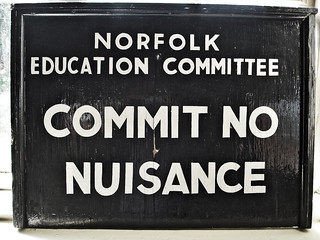 When people learn that I work in conflict resolution, they are often eager to tell me about the conflicts in their workplace. I hear about bad behaviour, bullying, rudeness, and the description usually builds to the following declaration:
“In any other workplace, this person would have been fired long ago!”
And at this point I have to smile, and suppress the urge to roll my eyes.
I have heard this claim from people in large organizations and small, unionized and non-unionized, industrial and academic. Many people are under the impression that their workplace is uniquely dysfunctional and that the person they have told me about – whether a supervisor, co-worker, or employee – is distinctively awful. The unfortunate reality is that bad behaviour in the workplace is widespread, and no matter how often I hear about it, my heart always goes out to those affected. Workplace strife and conflict take a terrible toll, not only on the financial well-being of organizations, but also on the mental and physical health of everyone who must deal with it.
While the claim that things would be different in “any other workplace” is not literally true, it does point to an underlying fact about workplace conflict. Although every unhappy workplace (like every unhappy family) may be unhappy in its own way, certain structural factors in organizations make workplace conflict particularly difficult to manage. Let me just mention two:
First, the offending person is likely to be perceived as providing great value to the organization. Maybe he or she is the top salesperson, or has some hard-to-replace set of skills, or is well-connected within upper management. Whatever value this person brings is perceived as making up for or out-weighing the grief that he or she causes.
The key word here is “perceived.” It is an open question whether the “value” that a conflict-prone employee brings to an organization really out-weighs their overall cost. If someone took the time to crunch the numbers, they might be surprised at how they work out. In his book, The No Asshole Rule, Robert Sutton tells the story of a men’s clothing store in which the top salesman was an overbearing jerk and made life miserable for the other employees. When he was finally let go, the store’s overall sales actually rose. Although this person was an effective salesman, his incivility and bad behaviour prevented others from succeeding. Sutton has many similar stories.
Second, there is often a view that, since it is “impossible” to get rid of the conflict-prone person, there is no point in confronting him or her about their actions or in hoping for any kind of behavioural change.
Is it really “impossible” for an organization to discipline or dismiss a conflict-prone employee? Only your HR specialist or employment lawyer may know for certain. As for the hope of behavioural change, I will say only that it will not happen if the employee in question is never confronted about his or her actions. Conflict-prone employees often lack insight into the effect they have on others. They may genuinely not realize that their behaviour is unacceptable. If you are the supervisor of an employee who makes coming to work an ordeal for others and you have not discussed this with him or her, then (sad to say) you are part of the problem.
If a person in a position of power really believes that things would be different “in any other workplace,” then it may be time to ask what is holding your organization back from attempting positive change.
Subscribe to:
Posts (Atom)