Pages

Monday, September 30, 2013

When We Trust Our Intuitions


Photoshop: Lawyer JimI'm very happy to have an article, "When Lawyers Trust Their Intuitions" in the current issue of Canadian Lawyer's e-magazine.  Although the research I discuss was done with lawyers it is relevant to anyone who wants to make better decisions.


Read the article to learn about four different faulty cognitive strategies:  The framing effect, confirmation bias, nonconsequentialist reasoning, and the sunk cost fallacy.

Have you ever made a bad decision because you relied on one of these?  Leave me a comment below.

Tuesday, September 10, 2013

Why You Should Never Ignore a Letter from the Condo Board

♥ Mail Man ♥When I read about condominium disputes, I am often struck by how the conflict could have been resolved a lot sooner (and for much less money) if only the unit owner had responded to the Board’s letters.

 A typical scenario goes something like this:  The owner gets a letter notifying her that her dog Fluffy has been barking and annoying neighbours, or that her trumpet playing is too loud, or that the holiday decorations she has put up do not comply with the condominium’s rules.  The owner thinks –“There must be some mistake.  Fluffy never barks.” Or, “I never play the trumpet after 10 p.m.” Or, “I put up the same decorations last year and no one said anything.”  So she ignores the letter.  Or maybe she has a chat with the condominium manager, or with a board member, and feels reassured by what she hears.  Another letter comes regarding Fluffy (or the trumpet playing, or the decorations) this time from the board’s lawyer.  She ignores that as well, assuming that whatever problem there may have been has been resolved.  Before she knows it, she is summoned to a mediation with the board and is asked to reimburse the legal expenses that the board incurred in getting her to comply with the regulations.

 It is never a good idea to ignore a communication from your condominium manager or from the board, even if you feel that the complaint against you is ill-founded, or the matter is trivial, or that the rule you are accused of violating is unfair.  Condominium managers and boards have a duty to enforce condominium rules, to respond to complaints, and to persist until the matter is resolved.  It is always in an owner’s best interest to acknowledge and answer a communication from the property manager or from the board.  If you do not respond then the board has no way of knowing your perspective on the matter.

Instead of ignoring a letter do the following:
  1. Respond in writing.  Acknowledge receipt of the letter.  If the complaint is based on a misunderstanding or on false information, explain.  (“Fluffy was with me at the cottage during the week in question. Hence the barking must have come from another unit.”)  If the complaint is legitimate, explain how you will address it.  (“In the future, I will limit my trumpet playing to between the hours of 4 and 5 p.m.”)
     
  2. Respond promptly, but if the letter has upset you (“How dare anyone object to my holiday decorations!”) wait until you have relaxed enough to write a calm letter.  If you have a friend whom you feel has good judgment, ask him or her to read over the letter before you send it.
     
  3.  If you have a conversation with the manager or a board member about the contents of the letter, document this as well.  Soon after the conversation, summarize the main points  in writing and send it to the person you spoke with.  Ask if he or she has anything to add or notices any errors or misunderstandings.
     
  4. Maintain a paper trail.  Keep copies of letters and emails about the issue.  If the matter goes further – say to arbitration – it is important to have some record of communication.  Memories fade and managers can be moved to other properties.  Above all, you will want to be able to show an arbitrator or judge that you acted responsibly and took reasonable steps to resolve the conflict.
     
  5. Get legal advice, especially if the matter does not seem resolved with your written reply to the initial letter.  It is important to seek advice from a lawyer who has experience with condominium matters.  Don’t ask your cousin the criminal lawyer or one of the in-house lawyers at your workplace.  Paying for good advice early in the process might save you a lot of money later on, should the conflict not resolve easily.

For the most part, disputes between condominium residents, or between unit owners and boards, do not simply fade away.  The early stages of a conflict are a precious time and the first moves made toward resolving a conflict can greatly influence the later stages. Don’t give up your chance to shape the outcome of a dispute by ignoring it in the early stages.


An edited version of this post was published on the "Condo Business" website.

Tuesday, September 3, 2013

Condo Law Digest – September 2013

elevator
Green v. York Condominium Corporation No. 834 and ThyssenKrupp Elevator (Canada) Ltd. 2013 ONSC 5004 (CanLII)
Decision Date: July 29, 2013
http://canlii.ca/t/g01g5

One evening in August 2005 Ms Green, a 72 year old resident of YCC 834, entered the elevator on the 16th floor intending to meet visitors in the lobby.  The elevator descended and stopped but the door did not open.  There had been very heavy rain for the past two days and, although Ms Green did not know it, many problems with the elevators.  When the doors failed to open she banged on them for help, and then used the emergency telephone inside the elevator to call the condominium gatehouse.  The person who answered said that he would send help.  After “a long period of time” without assistance of any kind, the elevator door opened a small ways (described by Ms Green as “five or six inches” at her examination-for-discovery and one to one-and-a-half feet at trial) and she tried to exit the elevator sideways.  As she did so the elevator moved again and propelled her out onto the lobby floor.  She slid across the floor and hit a pillar, injuring her head and shoulder.  Her visitors took her to the hospital where she was found to have a broken shoulder.

Ms Green made a separate agreement to settle her claim against YCC 834; the issue for this trial was whether ThyssenKrupp Elevator bore any liability for Ms Green’s injuries.  Her counsel argued that the company had failed in its duty of care under the Occupier’s Liability Act.  Justice O’Marra dismissed the claim based on the following reasons: 1) ThyssenKrupp is not an “occupier” under the Act but an independent contractor; 2) There was no evidence of negligence on their part, and no connections made between their actions and Ms Green’s injuries; and 3) Ms Green was “the author of her own misfortune” because she left a place of safety (i.e. the stuck elevator).

Comment:  It is surprising to me that a stuck elevator would be considered a “place of safety.”

673830 Ontario Limited v. MTCC 673, 2013 ONSC 5218 (CanLII)
Decision Date: August 16, 2013
http://canlii.ca/t/g053b

In May 2011 at MTCC’s annual general meeting unit owners were told that the corporation would receive a payment from the City of Toronto because of an earlier expropriation of common elements land by the TTC, and that this payment would cover the cost of urgently needed roof repairs.  In August the corporation received a payment of about $750,000.  In September the applicant made an offer to purchase one of the building’s units, conditional upon receiving and approving the corporation’s Status Certificate.  The Certificate stated that the Board anticipated that the reserve fund would be adequate in the current fiscal year for the expected cost of major repairs. In November the Board issued a special assessment to unit owners for $1,000,000 for the cost of roof repairs; this was cancelled when it was determined that the roof replacement cost could be lowered.  In February 2012 the Board held a special meeting to explain that the payment from the TTC would cover the expected cost of roof repairs.  Certain unit owners wished to be paid their share of the monies directly (rather than have them applied to the roof repairs) and so the Board issued a second Special Assessment in the exact amount of the TTC payment.  (Whether a unit owner elected to have his share of the TTC payment applied directly to the roof repair, or to pay the assessment and then receive a share of the payment, there would be no net change to the owner’s finances.)

The Applicant demanded a share of the TTC payment.  It argued that it was not informed in the Status Certificate, either about the pending roof repairs or about the anticipated payment from the TTC, and so should be exempt from both Special Assessments.  The Board argued that the Applicant should not profit from the TTC payment without contributing to roof repairs, and that the second Special Assessment was issued for “administrative purposes” only.  The Judge found that the Status Certificate was accurate when it said that the reserve fund would be adequate to cover the cost of anticipated repairs and that the Applicant had not been treated differently from other unit owners.  The application was dismissed.

Comment: Sometimes a Special Assessment is not a Special Assessment.

Friday, August 2, 2013

Condo Law Digest – August 2013

Balloons for Sale
York Condominium Corporation No. 345 v. Qi, 2013 ONSC 4592 (CanLII)
Decision Date: July 8, 2013

In January 2006 Mr. Qi, a unit owner at YCC 345, defaulted in the payment of common expenses when his cheque was returned NSF.  This prompted a lien on his unit.  The original default of around $500 increased with the addition of interest (at 12% per annum), $25/month service fee, and legal fees.  In Spring 2012 YCC 345 successfully brought a motion for summary judgment, and by that time the debt had ballooned to about $33,000, and the costs for the summary judgment motion brought it to over $46,000.  Mr. Qi, who was not represented at the time of the motion, retained counsel who appealed the summary judgment and asked for a costs assessment.

Counsel for YCC 345 argued that the corporation should recover its full legal costs, as provided for in the Condominium Act and in YCC 345’s Declaration.  Justice Quigley disagreed.  Although the Condominium Act creates a framework for governance, “the directors of condominium corporations are counted upon to act with prudence and reasonable good judgment.” He found that costs should be assessed on a partial indemnity basis, and his reasons include 1) the legal costs were “immensely disproportionate” to the arrears of common expenses; 2) YCC 345 could have taken steps to reduce the conflict; 3) Mr. Qi had offered to settle the matter in 2009, and if reasonable efforts had been made to find a solution, the greater part of the legal expenses would never have been incurred.

Comment:  Another judgment stressing that legal fees and related costs must be reasonable.  Condominium corporations cannot expect that any and all costs will be passed on to defaulting unit owners.

Tuesday, July 30, 2013

If a Tree Falls …. Do We Have to Fight About It?

"Hey, you woke me up!"
I’ve written before about how microwave ovens are a source of conflict among co-workers.  When it comes to conflict between neighbours, trees appear to be a leading source of tension. Now a recent court case about a Toronto tree has clarified some of the legal issues relevant to trees in Ontario.

It would seem to be common sense, as well as a provision of the Forestry Act, that if a tree trunk is growing on the boundary between two lots, then the tree is the common property of the adjoining landowners.  If a tree is indeed jointly owned, and one of the owners wants to remove it, the other owner must agree.  However the Forestry Act does not specify where the tree’s trunk begins and ends.  If the trunk of the tree emerges from the ground directly over the property line, then the tree is pretty clearly jointly owned.  But matters are rarely so simple.

In the Toronto case the tree trunk met the ground on Katherine Hartley’s property, but its roots, canopy, and part of the trunk extended over the property boundary into her neighbours’ back yard.  At some point (and for reasons that were not clear in the legal documents) Hartley came to the conclusion that the tree was unhealthy and decided to have it removed.  Her neighbours, Hilary Cunningham and Stephen Scharper, would not consent to the tree’s removal, so Ms. Hartley sought the court to declare that she was the sole owner of the tree and so did not require her neighbours’ consent. 

The judge dismissed her application and found that the tree was jointly owned.  After hearing expert evidence from two arborists and a landscape architect, and reflecting on the dictionary definition of “trunk,” the judge wrote that the relevant section of the Forestry Act, “includes within the ambit of the meaning of a tree trunk growing on a boundary line the entire trunk from its point of growth away from its roots up to its top where it branches out to limbs and foliage. In any event, it is not only the arbitrary point at which the trunk emerges from the soil that governs.”  Furthermore, since Ms. Hartley provided no evidence that the tree was unhealthy, her “wish to remove the tree falls short of a need to do so.”  In a subsequent decision the judge awarded costs to Cunningham and Scharper on a “partial indemnity” basis – in other words, besides having to pay her own legal costs, Hartley was responsible for paying over $13,000 of her neighbours’ costs.


Is this a conflict that should have been mediated?  There is no doubt that mediation would have been less expensive than litigation.  And since Hartley, Cunningham and Sharper will presumably continue to live next to one another they would have benefited from mediation’s ability to preserve and even strengthen relationships.  While I am a strong proponent of mediation, I also realize that it isn’t right for every case, and I do not have enough information to guess whether a mediation could have been successful in this particular case.  However Justice Moore’s decision makes it clear that if a tree is jointly owned then its future has to be determined by both owners.  His ruling should help neighbours in similar situations understand the legal landscape, so the speak, and assist them in coming to mutually agreeable decisions.

Monday, July 29, 2013

Summer 2013 Newsletter Available

Zarko Drincic - Yesterday newsMy latest newsletter tells you all about "How to Escalate a Conflict" and is available on the Newsletter Archive page of Principled Dispute Resolution and Consulting.  Subscribe to make sure that you don't miss an issue!

Monday, July 8, 2013

Condo Law Digest – July 2013

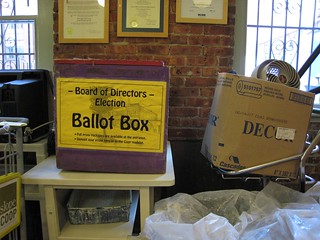
Ballot Box
Davis v. Peel Condominium Corporation No. 22, 2013 ONSC 3367 (CanLII)
Decision Date: June 7, 2013

As readers will probably know, condo board members may be removed from a board before the end of their term if more than half of all unit owners vote to remove them.  However, according to the Condominium Act, owners are not eligible to vote if, at the time of the meeting, any contributions payable with respect to their units have been in arrears for more than 30 days.  A group of owners at PCC 22 requested a meeting with the intention of removing the board.  At the meeting, held in October 2012, the lawyer representing the corporation ruled that 12 proxy votes were ineligible due to unpaid accounts, relying on records supplied by the property management company.  The group that had requested the meeting brought their own lawyer.  She objected to the first lawyer’s appointment as chair of the meeting (on the grounds that the person who appointed him was not authorized to do so) and was herself elected chair by a majority of those present.  Based on updated information, she ruled that the 12 proxy votes were indeed eligible and the board was voted out.

Ms Davis, a unit owner, brought an application alleging that the second lawyer had acted in bad faith and had allowed “ballots in the box that should not have been in there.”  The judge rejected the application.  He reviewed the information that the second lawyer had used to accept the proxies and ruled that three had been incorrectly allowed.  Yet given the margin of victory in favour of removing the directors, these incorrectly accepted proxies did not make a difference to the outcome of vote.

Comment: An accusation of bad faith is serious; persons are presumed to act in good faith unless proven otherwise.  (See the Supreme Court of Canada ruling in Blair v. Consolidated Enfield Corp.)

Taipaleenmaki v. M.T.C.C. 1053, 2013 HRTO 1100
Decision Date: June 20, 2013

In December 2010, Ms Taipaleenmaki, a unit owner, was asked to remove a Christmas plaque from her door.  She filed an application with the HRTO alleging discrimination on the basis of creed.  The application was settled at mediation one year later.  In the current application Ms Taipaleenmaki alleges a pattern of harassment by the Board that is a reprisal (or threat of reprisal) for the earlier complaint.  She submits that the Board has refused to meet with her on a number of occasions to discuss a wide variety of issues (including a new non-discrimination policy, the Privacy Act, a monthly maintenance fee increase, window washing, and the Veterinarians Act of Ontario, to name a few), that the president of the Board ignored her questions at condominium meetings, and that several of her postings to the condominium’s website were removed.

The Adjudicator dismissed the application as having no reasonable prospect of success. Ms Taipaleenmaki provided no evidence that the Board’s actions constituted a reprisal or attempt at reprisal.  Although the Board declined to meet with her, they suggested that a Committee meeting or Town Hall meeting would be a more appropriate forum for her concerns.  When Ms Taipaleenmaki’s posts were removed from the condo’s website, a letter from the Board’s lawyer advised her that these posts were defamatory and asked her to abide by the rules for posting.  While there are a number of outstanding disagreements between Ms Taipaleenmaki and the Board, and she feels aggrieved, the HRTO cannot deal with general allegations of unfairness.

Comment: Disagreements in themselves are not necessarily evidence of human rights violations.